


MIXED FEELINGS: Season 1. Episode 3.
Feat.: Florian Jäger, Philipp Wunderlich, Ilya Yablokov. Hosted by: Polina Aronson.
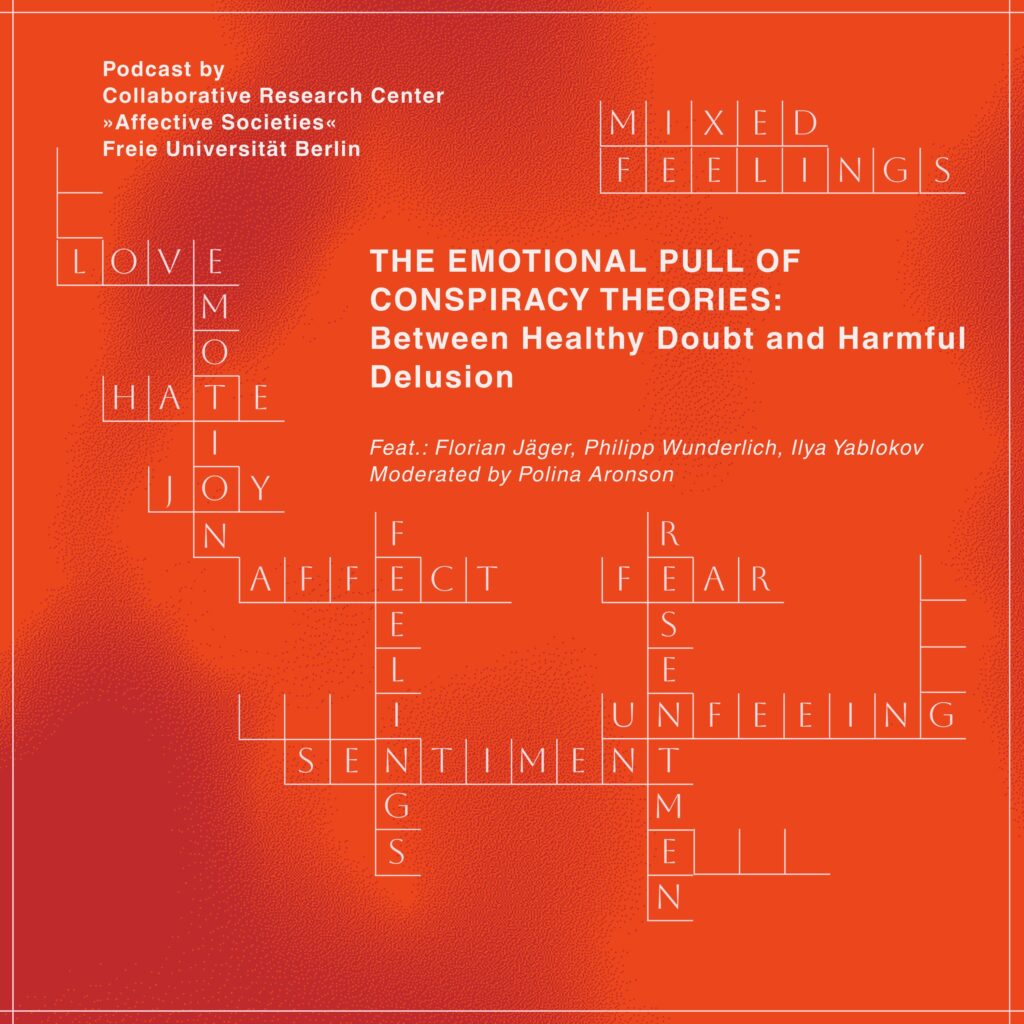
Conspiracy theories seem to offer more than explanations — they provide emotional orientation, a way of making sense of an increasingly complex world. Perhaps the challenge is not only to debunk them, but also to understand the emotional needs they respond to — and to ask how those needs might be met differently.
In this new episode of Mixed Feelings, we explore conspiracy theories not primarily as a question of truth or falsehood, but as emotional phenomena. What do conspiratorial narratives do for people? Why do they feel so compelling, even when they seem implausible? And what do they reveal about the societies we live in?
Together with sociologist Philipp Wunderlich, media scholar Ilya Yablokov, and Florian Jäger, psychologist and counsellor at the Berlin-based counseling centre Veritas, we look at both the theoretical and the lived dimensions of conspiracy theories — from their emotional appeal to the everyday realities of being affected by them, directly or through family and friends.
