


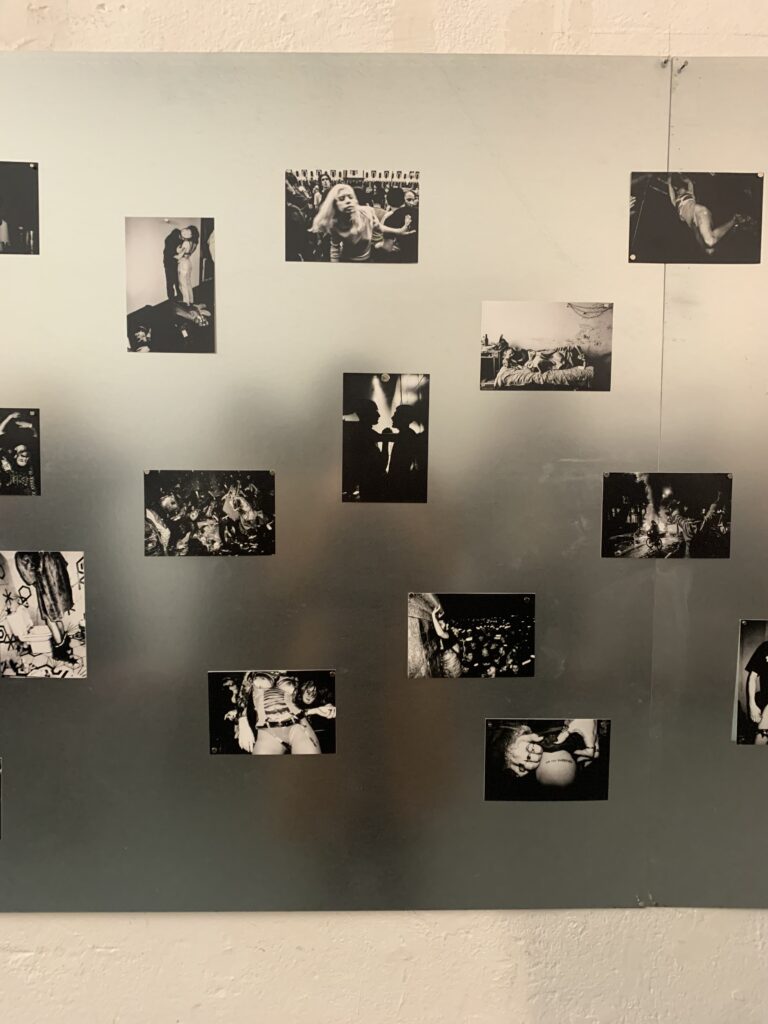
© Mariam Giunashvili, photograph by Ana Makhashvili
I hesitate to write about this because writing suggests a sense of retrospection, that something is over, that there is enough temporal and spatial distance to allow for reflection. But what I want to write about is ongoing. Even if the intensity of the demonstrations has subsided, the general atmosphere has not settled but rather shifted, slowly, from a revolutionary rage fused with the pleasure of resistance into something closer to paranoia, fear, and a seeping hopelessness.
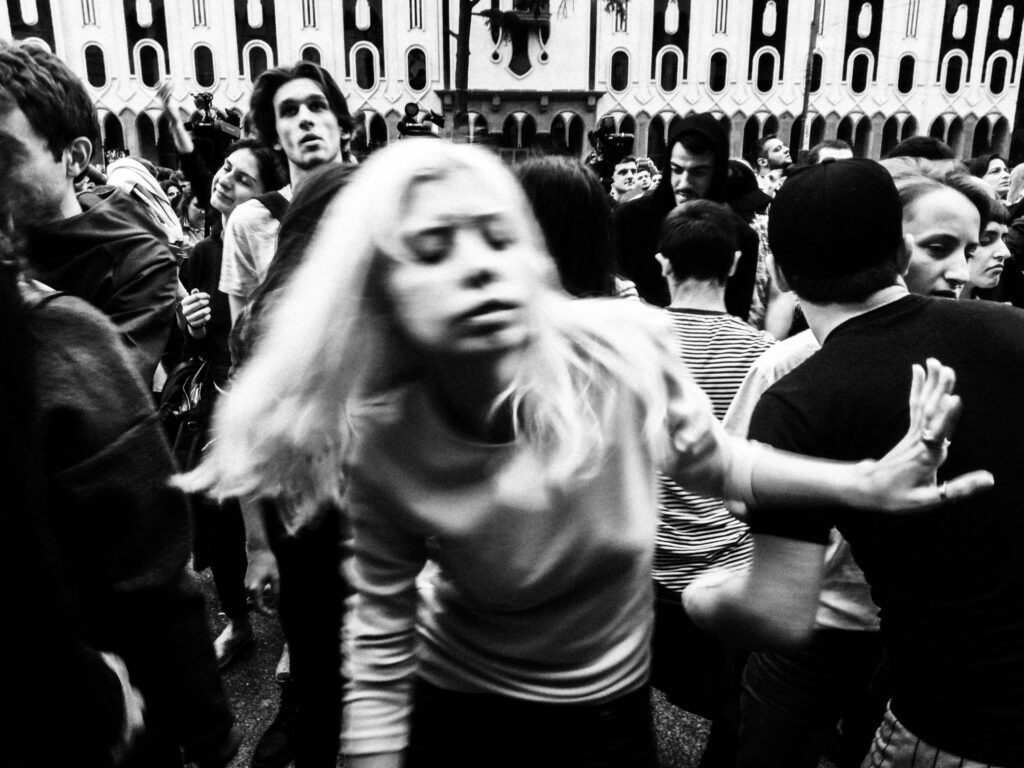
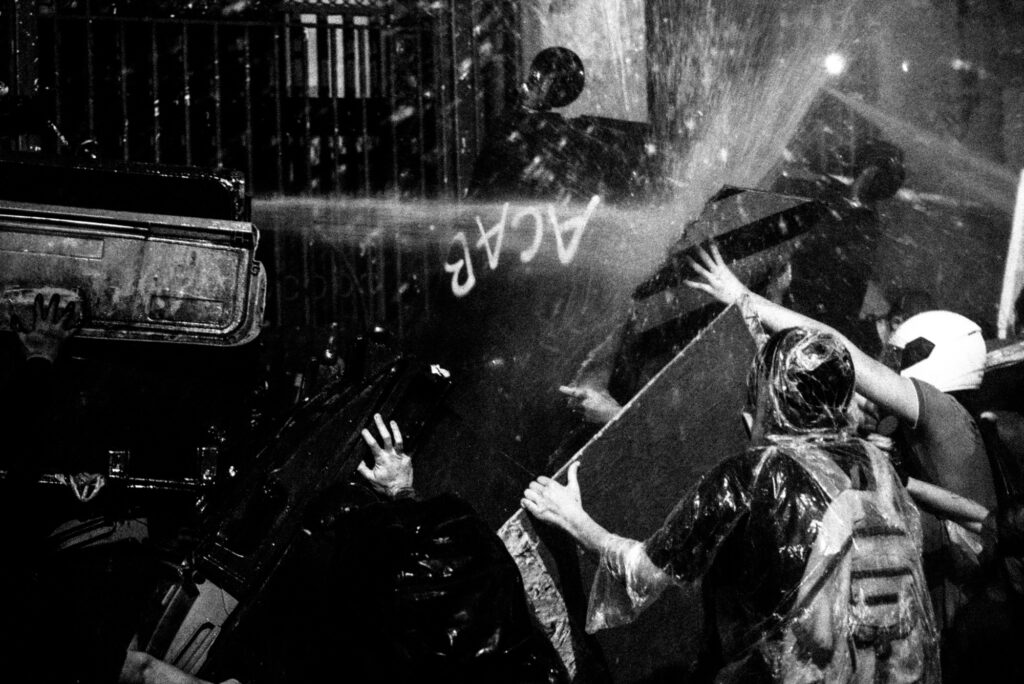
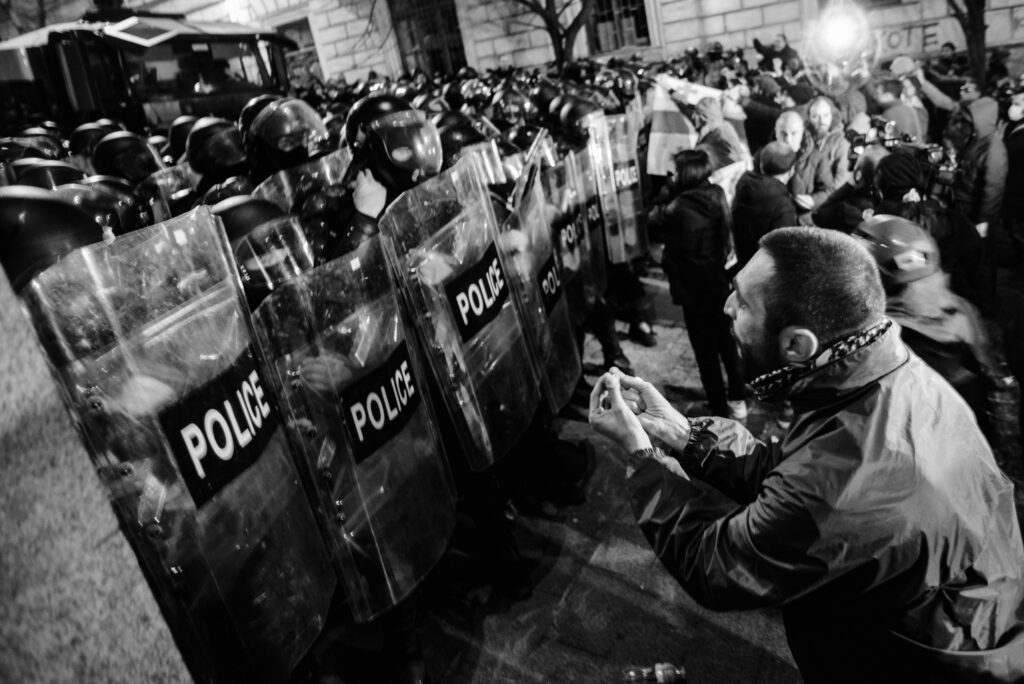
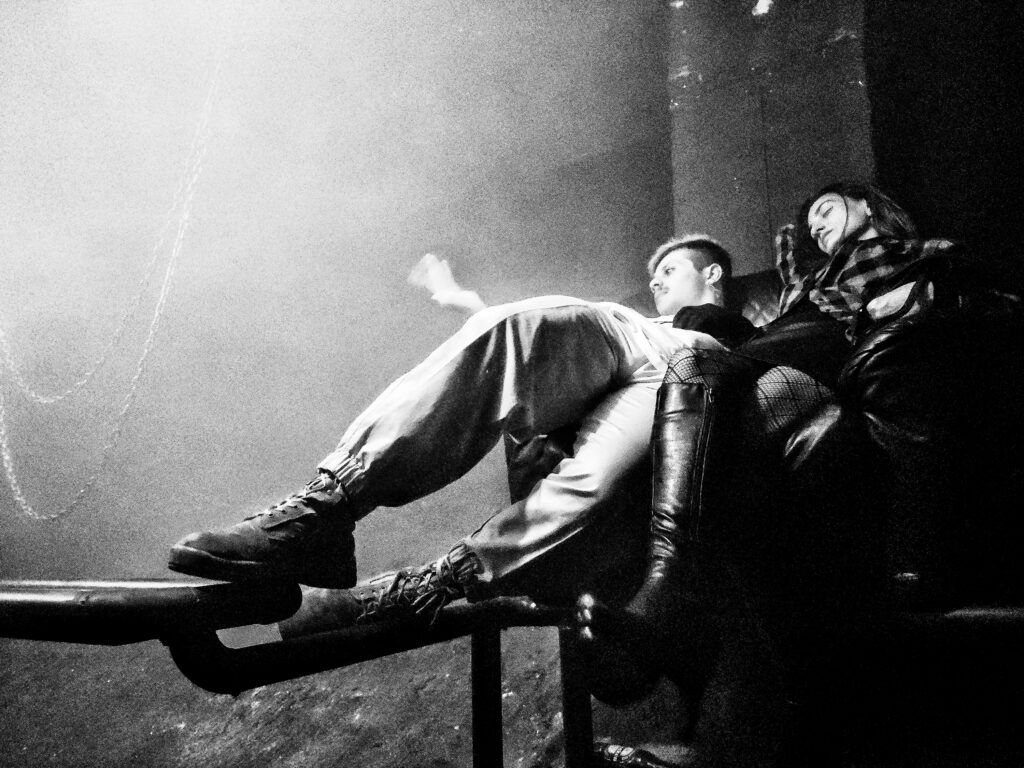
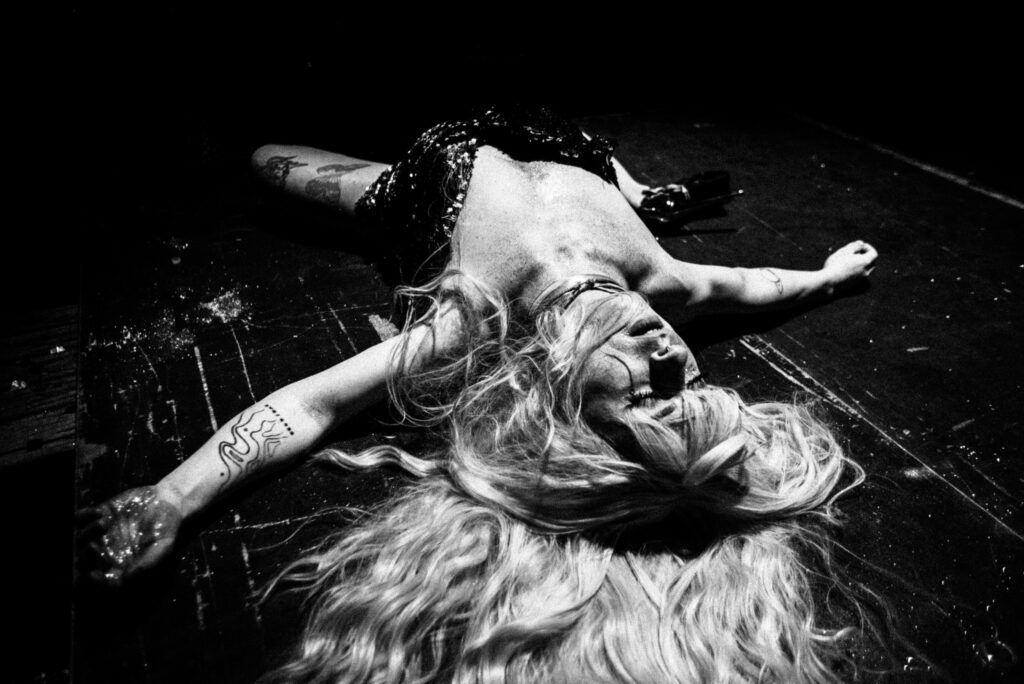
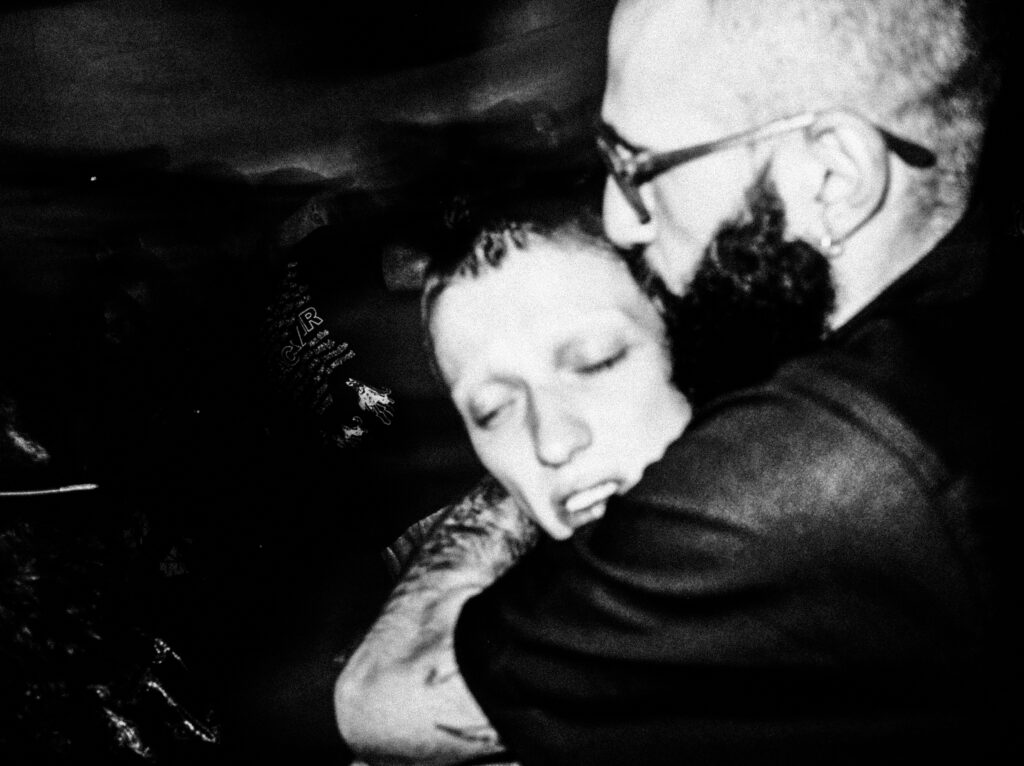
This evening (March 17), I went to Halfsister, a gallery space in Berlin run by two Georgian sisters, for an exhibition by Mariam Giunashvili (მზესუ), a Georgian photographer, titled Disposable Highs. The mostly black-and-white photographs move between intimacy and rupture. Many were taken in Tbilisi’s (now closed) alternative bars, where the artist worked—sometimes at five bars at once—ending nights, or rather mornings, in nightclubs before returning to work again. These images capture closeness, elation, and a kind of familiarity that feels almost tactile. They are set against a different visual register, one that feels cold, displaying brutal encounters from demonstrations on Rustaveli Avenue over the past decade.
© Mariam Giunashvili
The most recent wave of protests, following the 2024 parliamentary election fraud allegations, did not emerge in isolation. Nor were they simply triggered by the governing party’s (ironically named Georgian Dream, GD) deviation from its EU accession path, even if this was mainly accentuated in Western media coverage. The protests have been ongoing, though often dispersed and fragmented, shaped by a range of struggles: against the government’s close ties to Russia with its long history of imperial domination in the region; for workers’ rights, including multiple miners’ and factory strikes; for climate justice; as well as for women’s, queer, and disabled people’s rights. These dimensions are often flattened or erased in international coverage. At the same time, as has become painfully clear, even within anti-government movements, marginalized voices remain marginalized. The government launched, or rather intensified, its anti-LGBTQI campaign prior to the last election, strategically redirecting attention away from economic decline, rising inequality, and ongoing protest—a political maneuver that appears as effective in rural Georgia as it does in Washington, D.C.
© Mariam Giunashvili
The photographer returns to this point when speaking about how many of her queer and trans friends have left the country, unwillingly, in search of the right to live elsewhere. At the same time, she expresses discomfort—almost embarrassment—for speaking about, or as she humbly phrases it, “complaining” about the political situation in Georgia, given that other parts of the world are experiencing far more immediate devastation and violence.
This hesitation resonates with me. It takes me back to late November/early December 2024, when I spent several days unsure whether to fly to Tbilisi to join the newly re-erupted mass protests. Going would have meant abandoning the weekly demonstrations against the genocide in Gaza that I had been diligently attending in Berlin. What felt like choosing one struggle over another filled me with a sense of embarrassment—of a commitment that felt uncomfortably nationalist. I returned a month later carrying a different kind of shame, that of not having fully committed to that struggle either. Knowing that these movements exceed any individual’s presence or labor did not dispel these feelings.
As the slideshow shifts from parties and afterparties to burning cars and clouds of tear gas, the artist speaks about how the initial hope gave way to a creeping paranoia among protesters. People began to question whether certain actions were initiated by demonstrators or orchestrated by the police to justify deploying violent measures.
© Mariam Giunashvili
The mention of paranoia pulls me back again, this time to Chavchavadze Avenue, where I went directly after landing in Tbilisi, joining a demonstration that began in a university courtyard. I remember the panic rising in my body (as it often does at protests), which was almost immediately accompanied by a sense of belonging, when people around me immediately offered me various calming medication that everyone seemed to have ready at hand. Most people there were already familiar with the anxiety that settles into the body after repeated confrontations with the police. I remember, too, the constant, almost ritualized speculation about who among us might be a government informant, which became a way of passing time during days that sometimes stretched into eight hours of continuous protest. Few of my friends half-jokingly compared going to protests to going to work, which some of them working remotely actually did on the sidewalks in-between protesting. Of course, going to demonstrations is not a paid labor, but rather often led to the imposition of constantly increasing fines.
Hearing this described now, more than a year later, reactivates in me a strange urge to defend paranoia as a politically viable affect. I think of Eve Kosofsky Sedgwick’s (1997) famous critique of paranoid reading, as a mode of thinking driven by suspicion and the anticipation of harm, oriented toward exposing hidden structures of power, and which she contrasts with reparative reading as a practice open to surprise, sustenance, and repair. And yet, I find myself wanting to return to paranoia—not as a totalizing epistemology, but as a response to conditions in which paranoia can feel unavoidable, even vital, if painful. Although writing now from afar complicates my claim to paranoia as a shared and, at times, necessary affect for the survival of the movement, I find it increasingly difficult to rely on the language of repair, when more and more lives are rendered disposable or impossible, imprisoned or forced into exile. When those who were courageous enough to resist are forced to leave, scattering networks of solidarity across borders, the question remains, how can these networks be reassembled.
© Mariam Giunashvili
Surely, it can be argued that paranoia forecloses the possibility of relation; yet it also crucially sharpens attention toward risk and infiltration, thereby sustaining collective awareness crucial for the survival of the movement. Moreover, the issue with the language of repair is that repair does not necessarily resolve structural problems but rather, it sometimes means to simply resolve the rupture and go back to the ordinary, which remains oppressive. At other times, it means that one repressive regime is replaced by another. Paranoia, in contrast, may intensify the urgency to find new, potentially less easily co-opted and more resilient forms of relation. In this way, it may allow to reassemble solidarity networks—unevenly and not without loss, but perhaps less bound to the nation-state and also, less invested in disavowing the ambivalences that traverse identity- and issue-based communities. The challenge, then, is not to move beyond paranoia, but to ask how it might coexist with practices of connection that are rooted in nonsovereign relationality (Berlant, 2022). This is not to depart from Sedgwick’s insistence that paranoia is one mode among others and not without its limits, but rather to emphasize how it can still serve protest movements, as it remains particularly difficult to refrain from paranoia under highly authoritarian regimes.
When someone in the audience tries to offer reassurance (probably discomforted by the artist’s seeming loss of hope and her grief of the places and faces depicted in her pictures), commenting “but we will win, eventually,” the photographer hesitates. But it seems to me that her hesitation, like the shame and paranoia she describes, is not paralyzing. It is not oriented toward political nihilism. It conveys knowledge and it does not need to be corrected with false positivism. It points to the issues the movement is facing, most notably, its forced fragmentation. Her discomfort with speaking about Georgia in the context of ongoing wars elsewhere does not diminish or delegitimize the struggle; it situates it within a broader, interconnected landscape of authoritarian resurgence.
© Mariam Giunashvili
Showing photographs from drag shows in Tbilisi, she notes the current absence of community, of shared space within the queer scene eroded by fear. This is not an expression of fatalism. It is a way of naming what is missing, and therefore what might be needed.
The photographs themselves—despite their black-and-white palette—are vibrant, usually capturing movement, whether on the dance floor or in the streets. They capture the mood of the early and mid-2010s, with the city’s emerging techno scene, queer bars, and drag shows, as both repressive and hopeful: a time when, at least in the intimate public of the club, ways of living beyond the norm could be celebrated, and the outside world momentarily held at bay. Fittingly, and maybe also unfittingly, she first shared these images in a Facebook group called sans sentiments or without feelings.
As of now, what remains from these pictures is not resolution but a sharpened sensitivity to repression, fragmentation, and to the fragile conditions under which something like solidarity can still be felt.
Perhaps writing too does not require distance or resolution after all, but only a willingness to remain with what has not yet settled.
© Mariam Giunashvili
References
Berlant, L. (2022). On the Inconvenience of Other People. Duke University Press.
Kosofsky Sedgwick, E. (1997). Paranoid Reading and Reparative Reading; or, You’re So Paranoid, You Probably Think This Introduction is About You. In E. K. Sedgwick, J. Goldberg, M. Moon, & M. A. Barale (Eds.), Novel Gazing: Queer Readings in Fiction (pp. 1–38). Duke University Press.
