


Monumentalization means enforcing an official version of memory. There is a “fantasy of immortality embodied in the monument” (Sakr, 2012, p. 51). This essay (which is based on my talk at the CRC Affective Societies on June 27, 2025) aims to engage the question of monuments in Turkey within the framework of what I have named the “imperial complex.” I argue that despite the hegemonic conviction that Turkey was not colonized, the colonial conditions of national sovereignty under the name of “Westernization” have produced complex affects that still resonate in the present anti-Western discourses of power in Turkey. The rupture with the Ottoman imperial past remains unresolved. There is an ambiguity of Westernism and anti-Westernism that destabilizes the fantasy of immortality embodied in monuments, and that radiates “monstrous” affects. The imperial complex is a dynamic of affects that oscillate between denial and resentment, glory and despair, and superiority and inferiority. I also argue that the affects in circulation mostly remain unrecognized, which can be best observed in monuments that turn into “monsters”—a term that empirically emerges in the very discussion regarding the monuments and statues in Turkey.
History and Affects
Richard Ellmann cites an incident in Paris in 1920 when Valery Larbaud said to James Joyce as they drove in a taxi past the Arc de Triomphe with its eternal fire, “How long do you think that will burn?” Joyce answered, “Until the Unknown Soldier gets up in disgust and blows it out.”
(Sakr, 2012, p. 41)
It is difficult to perceive the impact of the past on affects in the present. When we talk about affective mobilization today, it is mostly assumed that the affects that circulate and mobilize people are the products of the present and that they are governed and channeled by the existing power regimes. However, recognizing the vertical axis is also important since the sediments of the past have a significant role to play in shaping present affects. Affects are nonsynchronous and always operate in complex multi-temporal planes. The power regimes may address the sedimented affects of the past and seductively activate them in the present. It could be helpful to remember the words of Ernst Bloch in his book Heritage of Our Times, written in the early 1930s that “Nazis, rather than Marxists, had effectively linked the living memory of less alienated ways of life to current ‘pent-up anger’ in order to propel mass revolt against the present” (cited in Wilder, 2022, p. 179). According to Bloch, we must take into account the “nonsynchronous contradictions” in the present.
I am interested in how history not only shapes the present but also obstructs thinking and feeling otherwise. Sara Ahmed argues that “when history accumulates, certain ways of doing things seem natural” (cited in Houlton, 2022, p. 135). What is history then? Here, history is not only the official historical narrative or the hegemonic ideology but also sedimented implicit tropes and feelings that shape our ways of making sense of present events as well as imagining a future. History weighs on the present, mostly in repetitive patterns.
History also has a strong affective charge on the present because we take active part in its process, which is accompanied by a variety of memories and feelings ranging from longing and anger to complicity and resistance. The rulers who claim to make history are quite loud, but the governed, who also take part in shaping history, are mostly invisible, struggling, and tormented agents. I think Adrienne Rich’s (2009) poem Benjamin Revisited gives a very vivid image regarding the role of the governed in making history:
The angel
of history is
flown
now meet the janitor
down
in the basement, who
shirtless, smoking
has the job of stoking
the so-called past
into the so-called present
Many people are involved in stoking the past into the present, and in doing so, they are fighting with each other over memories and feelings, yet they barely recognize their ordinary lives and feelings in the idealized, monumentalized representations of history. Affects remain in circulation in unrecognized forms.
Monuments and Monstrosity
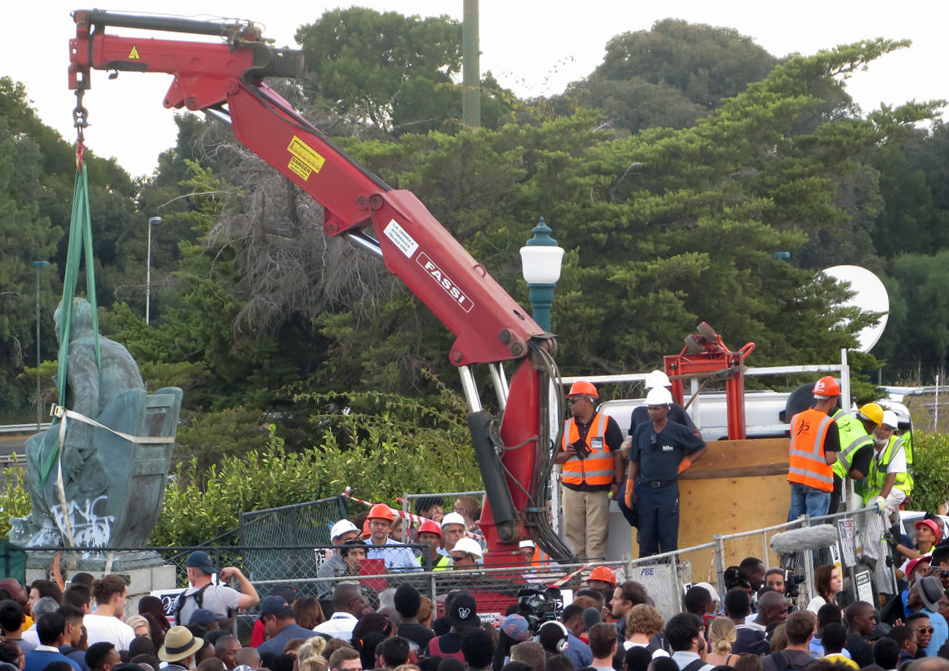
Monuments, which seek temporal fixity, are not just objects of analysis for me; I embrace anti-monumentality as a methodological principle for reflecting on history and affects. I follow Gary Wilder’s (2022) path of theorizing, which brings together Foucault’s concept of effective history and an immanent critique of the present. If the former “intervenes into the present by disclosing the arbitrary character of existing norms and arrangements, which emerged contingently through interested and violent historical processes” (Wilder, 2022, p. 160), the latter is attentive to the dialectic of past and future, to the potential germinating in the dark entrails of history. Both perspectives require dismantling the totality of history, or in other words, the illumination that comes from either metaphorically or literally toppling monuments. Achille Mbembe (2015, emphasis in original) argues that “bringing Rhodes’ statue down is one of the many legitimate ways in which we can, today in South Africa, demythologize that history and put it to rest—which is precisely the work memory properly understood is supposed to accomplish.” Bringing down the colonizer’s statue is an extensive act of decolonization. The removal of Cecil Rhodes’ statue in Cape Town, South Africa, in 2015 by the “Rhodes Must Fall” movement or the drowning of the monument of the slave trader Edward Colston in Bristol, Britain, in 2020 by Black Lives Matter activists reveal the “intersections between monuments, imperial/colonial legacies, and contemporary structural racism” (Houlton, 2022, p. 106). The toppling of monuments poses very significant questions regarding the investment, not only ideological but also affective investment, made in monuments. According to Michael Taussig (1999, p. 3), the destruction of monuments, or defacement, is like enlightenment; it brings insides outside, unearthing knowledge, and revealing mystery.
The monstrosity of monuments that I discuss here also reveals a mystery. The term “monster” frequently appears in the discursive field of contestation regarding monuments in Turkey (Ahıska, 2011). Many monuments are condemned and attacked as monsters either by the state or laypeople. But how do monuments turn into monsters? What does the monstrous reveal about history and affects? The French philosopher Pierre Ancet (2010) claims that, although monstrosity is a liminal concept like death, it is also different from death. Death imposes a necessary external limit, while the monster threatens from the inside. Ancet defines monstrosity as a problematic field of humanity, rather than simply being the form of the Other (p. 21). It cannot be simply defined as an “alterity” that is projected in opposition to the self; instead, monsters evoke painful interrogations about both the Other and the Self (p. 2). Similarly, Margrit Shildrick (1999, p. 81) has noted that “the monsters that engage us most, that command intricate explanation, are those which are closest to us, those which display some aspect of our own form, and speak both literally and metaphorically, a human language.” The monster has disturbing connotations. It embodies an uncanny presence that reminds of a denied and silenced past as well as the unrecognized affects of guilt and debt radiated by it.
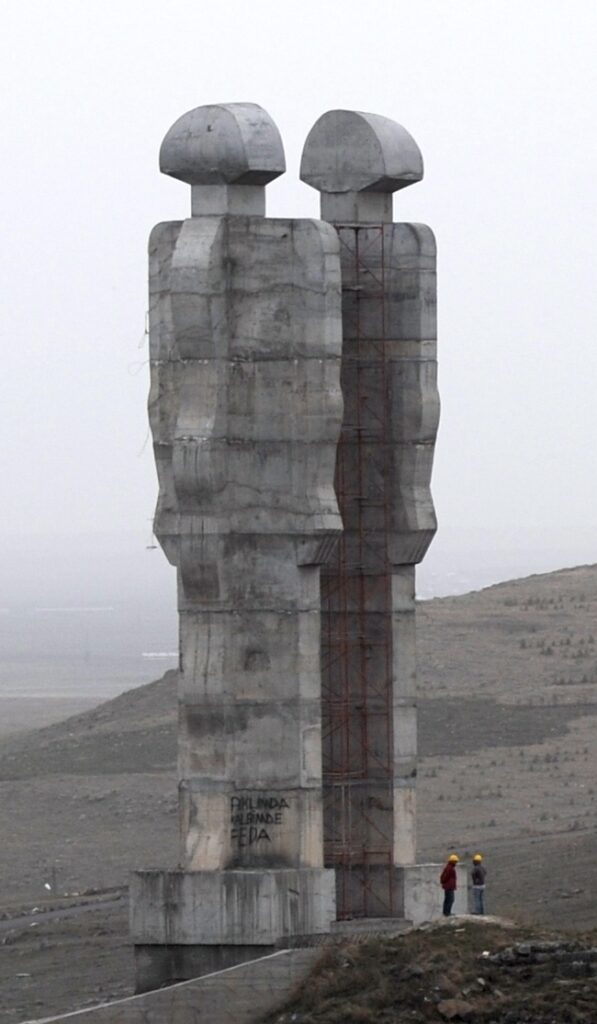
For example, the Humanity Monument in Kars, aiming to produce a sublimated conception of humanity and friendship, became a matter of serious dispute and was characterized as a monster. In January 2011, then Prime Minister of Turkey Tayyip Erdoğan visited Kars, a city on the Turkish–Armenian border, and when he saw the Humanity Monument under construction there, he called it ucube, literally meaning “monster.” The monument, sponsored by the previous mayor of Kars, was designed by the sculptor Mehmet Aksoy with the declared purpose of sending messages of friendship to the Armenians across the border. The artist has claimed that the monument is so tall (approximately 30 meters high) that it is visible from Armenia. However, the Prime Minister was quite straightforward in disclosing his dislike for the monument and consequently advising that the “monster” be demolished. The monument was demolished before completion.
Another “monstrous” example could be the statue of an Ottoman prince taking a selfie. This statue was erected in 2015 in Amasya, a town known as the hometown of many Ottoman princes during the Ottoman Empire. It was built by the Amasya municipality and was located near the Yeşilırmak river, a site of touristic attention. The statue is just one example of a series of monuments in different cities built by the local municipalities after the 2000s that aim to signify local values, including historical figures, but also local products and food such as meatballs and fruits. They are referred to as city statues. They are mostly mocked by people on social media, for example, on designated websites such as „The 54 statues which show the reasons why we have not yet become part of the Renaissance.“ The site is highly sarcastic regarding the sizes, shapes, and content of these statues. By invoking the Renaissance, the text uses the statues to illustrate Turkey’s supposed backwardness and ignorance vis-à-vis Europe. Similar to many other websites, as well as on different social media platforms, the main aim seems to be to make fun of these statues, which are widely perceived as ugly and monstrous. However, these statues, while supposedly signifying local histories, also foreclose the dangerous histories of the localities once inhabited by different ethnic and religious groups, such as Armenians, Rums, and Jews, now almost extinct due to a long history of state violence. I argue that the state violence reverberates in the vandalization of the token city statues. The prince also had his share of vandalism, first his phone, then his sword was broken.
Both the Humanity Monument and the Ottoman prince evade dangerous histories, albeit in different ways. Both invest in a certain cultural repertoire resulting from a denial of history. The prince taking a selfie is an anachronistic monument that trivializes history and invests in the futility of memory. The Ottoman past, which has been a problematic realm for the new Turkish Republic, is reduced to a comic-like figure. In the Humanity Monument, a particular conception of humanity is sublimated. The artist Mehmet Aksoy has explained that the huge figurative monument was intended to be an answer to the genocide memorial in Armenia just across the border. It suggests friendship evading the topic of genocide. Yet the affective charge of history is so much bigger; it does not fit neatly into the monumentalized representations. The prince was vandalized, and the Humanity Monument was sliced into pieces, starting with the head. It is reported that during the beheading of the monument, the workers were shouting “Allahüekber” (Şentürk, 2019, p. 308), echoing the battle cry historically used by Ottoman soldiers.
Occidentalism and the Imperial Complex
Scholars as well as artists usually define the problem of monuments in Turkey, such as many examples of government censorship, vandalism, and public dispute, in relation to backwardness vis-à-vis the West. Throughout my research, I have come across many comments uttered by the experts in the field of fine arts complaining about the level of art education and institutions in Turkey. They are not at the level of Western standards, they say. Many also refer to the people’s poor taste, which they hold responsible for the existence of “weird” or “monstrous” statues and monuments. Some accuse the untalented sculptors. Some would say that the Islamic values have hindered the development of the art of monument-making.
All of these remarks can be described as Occidentalist—a conceptual framework that I have offered and studied for a long time (Ahıska, 2010). After 1923, the Turkish Republic propagated a national identity that claimed to be both Western and authentic. There was a series of rapid reforms that adopted the Western script, time, law, and epistemology, introducing a huge rupture with the Ottoman past. Modern national performance was addressed to a projected Western gaze. The performative character of nationalism as a modern political form was accompanied by a feeling of urgency “to work for something which did not exist as if it existed and make it exist,” as the prominent sociologist Şerif Mardin (1981) has argued.
Turkish modern-national identity was erected on the basis of denial. We can reference the denial of the Ottoman past and significant events such as the Armenian genocide as major constituents of the regime of denial. Furthermore, the Turkification and criminalization of various religious and ethnic groups on the basis of privileging Sunni Islam meant the denial of the heterogeneous texture of the existing society.
In my book project, I aim to go one step further and address the very colonial framework within which Occidentalism as an ambivalent discourse (Westernism and anti-Westernism) has been produced. I want to point to the colonial conditions of Turkish national sovereignty and the consequential ambiguities, and address them within the framework of the imperial complex. The imperial complex addresses the complexity of feelings of superiority attached to the imperial origins of the nation state, as can be observed in the politics of the present regime in Turkey, which mobilizes affects of neo-Ottomanism and claims to be a superpower in the Middle East; but at the same time the feelings of inferiority in constant comparisons with the West due to having submitted to its terms but not quite acquiring the “real thing.” It addresses the “hidden injury” but also the delegated colonial sovereignty in ruling over the Other, such as non-Muslims, Kurds, and Alevis.
There is no closure to history in Turkey, and the unresolved past has the power to activate complex affects in the present. Unrecognized affects produce monstrous representations in the form of monuments and statues. They are not just symptoms of but also witnesses to the imperial complex. Recognizing the affects that produce the monstrosity of monuments may open up new ways for decolonizing the present and imagining the future.
References
Ahıska, M. (2010). Occidentalism in Turkey: Questions of modernity and national identity in Turkish radio broadcasting. I.B. Tauris.
Ahıska, M. (2011). Monsters that remember: Tracing the story of the Workers’ Monument in Tophane, İstanbul. Red Thread, (3). https://red-thread.org/wp-content/uploads/2018/12/2904977.pdf
Ancet, P. (2010). Ucube bedenlerin fenomenolojisi (E. Topraktepe, Trans.). Yapı Kredi Yayınları. (Original work published 2007 as Phénoménologie des corps monstrueux).
Houlton, T. (2022). Monuments as cultural and critical objects: From Mesolithic to eco-queer. Routledge.
Mardin, Ş. (1981). Religion and secularism in Turkey. In A. Kazancıgil & E. Özbudun (Eds.), Atatürk: Founder of a modern state (pp. 191–220). C. Hurst & Company.
Mbembe, A. (2015). Decolonizing knowledge and the question of the archive [Lecture manuscript]. Wits Institute for Social and Economic Research (WISER), University of the Witwatersrand.
Rich, A. (2009). Benjamin revisited. Michigan Quarterly Review, 48(1). http://hdl.handle.net/2027/spo.act2080.0048.111
Sakr, R. (2012). Monumental space in the post-imperial novel: An interdisciplinary study. Continuum.
Şentürk, A. (2019). Operasyon kamusal alan. Siyah Beyaz.
Shildrick, M. (1999). This body which is not one: Dealing with differences. Body & Society, 5(2–3), 77–92. https://doi.org/10.1177/1357034X99005002005
Taussig, M. T. (1999). Defacement: Public secrecy and the labor of the negative. Stanford University Press.
Wilder, G. (2022). Concrete utopianism: The politics of temporality and solidarity. Fordham University Press.
Edited by Maren Wirth and Annabella Backes
